The K-1 Visa Process is …

Stressful. Waiting to get married is stressful.  Waiting while physically separated from your fiance(e) is even more stressful.  Waiting to get married while physically separated and waiting for an immigration visa’s approval is extremely stressful.  Gafner Law Firm understands a couple’s stress while waiting for a K-1 or K-3 visa to be approved and it works hard to ensure that a couple is separated for as short a time as possible and that the time spent waiting is as least stressful as possible.

Long. The K-1 fiancee visa process takes many months to complete.  The first step in the process, submitting a petition to USCIS, is currently taking five months to complete.  Once that step is completed, a K-1 couple will need to complete additional steps before the k-1 beneficiary is allowed into the United States.  These steps can add many more months onto a couple’s wait.  If a mistake is made during this process, the wait may be extended by many additional months.    The firm works to ensure that a couple is separated for as short a time as possible.  Additionally, the firm guides each couple through the entire process (right up to when the fiance(e) enters the United States), and answers any questions or concerns that a couple might have during the process.

If you are thinking of applying for a K-1 Visa or K-3 Visa, please contact the firm and request a free fifteen minute phone conversation with an attorney.

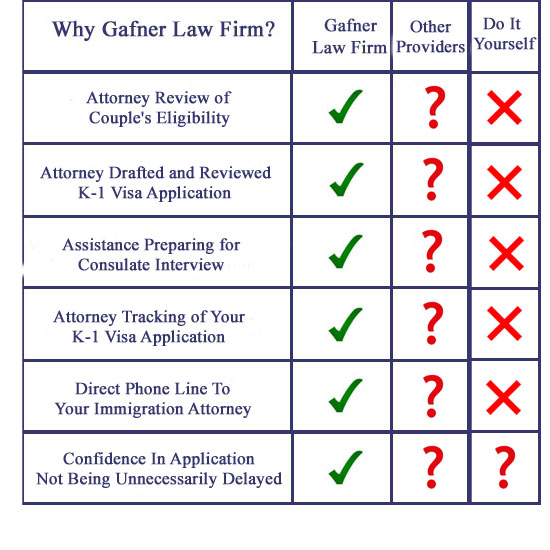
Why Gafner Law Firm?

The firm knows that a couple’s time a part is extremely difficult.  The firm works to ensure that a couple’s separation is minimized and that a couple does not have to spend that time worrying about the K-1 application.  The firm ensures that its clients have free, uninhibited access to an attorney.

Unlike many firms that only provide assistance while a couple is applying for a K-1 visa, Gafner Law Firm provides assistance to couples through the entire process – right up until the foreign national fiance(e) enters the United States.

The Firm has a 100% Money Back Guarantee for its K-1 visa and K-3 visa applicants.

The Firm’s founder has not only assisted clients in navigating through the K-1 process, but has also authored legal articles concerning the K-1 visa and has contributed to a chapter on the K-1 visa in a leading immigration law treatise.

Can an Engaged Couple File a K-1 Visa While the Foreign National Fiance(e) is in United States?

It often happens that a foreign national and his or her U.S. citizen lover become engaged while the foreign national is already in the United States.  In many cases, the foreign national fiance(e) is in the United States on a short one or two month long visit to see the U.S. citizen.   When a foreign national has become engaged and does not plan to leave the country for a few months, the question often comes up – can the foreign national fiance(e) of a U.S. Citizen apply for the K-1 fiancee visa while the foreign national is in the United States? This question is important because the K-1 process is a long process and couples don’t want to waste a few months of application time while the foreign national visits the United States.

So, can a Couple file a K-1 fiance(e) visa petition while the noncitizen fiance(e) is in the United States?

Generally speaking, the couple can file a K-1 visa application while the noncitizen fiance(e) is in the United States.   A couple will be able to skim a few months of their separation time while the K-1 application is pending.  The foreign national fiance(e) will be required to leave the United States for his or her consulate interview.   Once the K-1 visa is approved, the foreign national will be free to enter the United States and marry the US Citizen on the K-1 visa.

If you have any questions about the K-1 fiance visa, please do not hesitate to call or contact a K-1 visa lawyer.

Consular Fee for K-1 Visa Interview Increases

Starting June 4, 2010, all K-1 visa applicants will be required to pay a fee of $350 when they apply for a visa interview at their country’s U.S. Consulate.  The previous fee cost was only $131.

When a couple pursues a fiance visa (or fiancee visa), the couple must first pay a $455 fee to the US Citizenship and Immigration Services to process their I-129F form.  Once the I-129f form is approved, the K-1 visa applicant must apply for a visa interview at his or her country’s U.S. Consulate.  At this point is where the couple will need to pay the newly increased fee of $350.

The K-1 visa’s fee increase is apart of a overhaul of all nonimmigrant visa fees by the Department of State (DOS).  DOS has created a tiered payment level system, whereas all visa applications previously had a fee of $131.  The DOS is justifying the fee increase on the increased costs for completing the necessary security background checks (and other checks) needed before an applicant can be issued a K-1 visa.  The K-1 visa fee is the second most expensive fee in the new tiered system.

Unfortunately, this increase only means a couple must come up with additional money in an already expensive process.  In addition to the fees mentioned above, a couple will need to pay government fees of over a thousand dollars once the couple is in the United States and married.  These increased costs only add to the prudence of retaining a knowledgeable fiance visa lawyer to assist in a K-1 visa case.  If a couple makes a mistake, they may be forced to pay some, or all, of these fees again.  Guessing along the process just doesn’t pay off.

To read the Department of State’s statement on the fee increase, please visit:  http://www.state.gov/r/pa/prs/ps/2010/05/142155.htm.

Immigration and Marriage Fraud

Two recent episodes represent the continuing fraud that exists in the immigration system.  The first episode involves Mexican actress Fernanda Romero who is accused of committing marriage fraud by the U.S. Government.  Ms. Romero is accused of paying her husband to marry her so that she could become a permanent resident in the United States.  Ms. Romero was brought to the attention of U.S. authorities when a former boyfriend of hers told them.

The second episode involves a New York City Immigration officer who pleaded guilty to coercing a foreign national to perform sexual acts on him.   The USCIS officer was responsible for determining the eligibility of foreign nationals for family green cards.   The USCIS officer threatened her with a denial of her green card application and the deporting of her family members.

Should You Marry on a Tourist Visa?

fiancee visa fiance visa spouse visaMany couples believe that a foreign national fiance (or fiancee) can simply enter the United States on a tourist visa, get married and then stay in the United States without leaving the United States and without facing any consequence.  This idea is very appealing to couples as they do not want to wait for six months to a year for a K-1 fiancee visa or K-3 spousal visa to be approved.  They are in love, they want to be married, why shouldn’t they be allowed to quickly be together?

Unfortunately, reality is often very harsh to those couples who decide to forgo the K-1 fiancee visa and K-3 spousal visa. Often a couple will be accused of making a misrepresentation while they were applying for a visa and/or entering the United States.  The immigration agency often concludes that the foreign national’s temporary visa application intentionally hides the fact that he or she has a U.S. citizen spouse, fiance, or fiancee.  When a person applies for a tourist visa (or a student visa, or most other visas) he or she is seeking a temporary visa and is expected to leave the United States at the conclusion of his or her authorized stay.

If a couple is found to have misrepresented their relationship, the foreign national spouse will likely be required to leave the United States, and may face immigration consequences for the misrepresentation – including the possibility of being barred from entering the United States.

As you can tell – it isn’t wise to forgo the K-1 fiancee visa or K-3 spousal visa.  If you are marrying a U.S. citizen, or if you are already married to a U.S. citizen, please contact a family immigration lawyer to assist in your immigration to the United States.

Affidavit of Support for a Fiancee Visa: I-134 or I-864?

One of the greatest concerns that many couples have concerning the fiancee visa (or fiance visa) is whether the petitioner will be able to demonstrate that the beneficiary is financially supported.  This concern is especially acute for many fiancee visa applicants because many fall in love and decide to marry early in life when they are not yet financially secure.

The following is meant to provide some comfort to those fiancee visa couples stressed out about the Affidavit of Support and its requirements.  If you would like additional information about the Affidavit of Support and its financial requirements, please contact a K-1 fiance(e) visa lawyer.

What is an Affidavit of Support?

In essence, the affidavit of support is a contract between the immigrant’s sponsor and the American government.  In the affidavit of support the sponsor demonstrates that the fiancee visa beneficiary can be financially supported and will not become a “public charge” of the government.

Who needs an Affidavit of Support?

Most family-based immigrants are required to obtain a sponsor who will sign an Affidavit of Support for the intending immigrant.  Although there are many exceptions.  In most fiancee visa cases, the couple will need to complete two affidavits of support.  One affidavit of support must completed before the fiancee visa interview at a U.S. consulate.  The second affidavit of support must be completed after the couple is married and the foreign national spouse applies to become a lawful permanent resident.

Does a Fiance(e) visa couple need to complete the I-134 or the I-864?

A K-1 fiancee visa couple must complete both the I-134 and the I-864 forms.  However, the forms are not filed together.  Instead, the I-134 form must be completed before the fiancee visa interview at a U.S. consulate.  The I-864 will not need to be completed until the couple is married and the foreign national is adjusting status to become a lawful permanent resident.

What is the financial requirements?  What level of the U.S. poverty level must the U.S. citizen earn?

If the sponsor of the immigrant is the immigrant’s spouse, the sponsor must demonstrate that his or her income is at least 100% of the U.S. poverty level.

What happens if the sponsor does not earn enough money?

If the sponsor’s income does not meet the threshold amount, the sponsor can also demonstrate that his or her assets are significant enough to support the foreign national beneficiary.

When does these obligations end?

The sponsor’s responsibilities end when the beneficiary immigrant:

  • becomes a U.S. citizen,
  • earns credit for 40 quarters of work in the United States,
  • leaves the U.S. permanently, or
  • dies.

What if a couple separates, does the Affidavit of Support obligations cease?

No, the sponsor’s obligation does not end simply because the couple separates.

http://travel.state.gov/visa/immigrants/types/types_2994.html#Forms

K-1 Visa's Meeting Requirement Waiver: Beneficiary's Long Established Cultural Practice

Normally, the K-1 visa requires the K-1 applicants to meet within the two years immediately prior to the filing of the K-1 fiance visa.  However, the immigration agency allows for two exceptions to this requirement.  One exception is based upon the extreme hardship that would be felt by the K-1 petitioner.  The second exception is based on whether “compliance would violate strict and long-established customs of the beneficiary’s foreign culture or social practice.”

Many applicants who are cognizant of the exception mistakenly believe that they are eligible.  Given the USCIS’s interpretation of the regulations, however, it is extremely difficult to establish one’s eligibility for this exception.  Many cultures and religious do not approve of a couple meeting before their wedding.  However, in the modern age many couples do not always completely comply with their cultural and/or religious practices.  The USCIS has repeatedly ruled that if a meeting is not approved of by a religion or culture, but is tolerated nonetheless, the meeting requirement will not be waived.

It is possible to obtain a waiver of the meeting requirement because of the beneficiary’s long standing culture or religion.  However, to be successful it is necessary for an applicant to thoroughly demonstrate the cultural or religious practice forbidding the meeting.  Gafner Law Firm is a NYC fiance visa law firm that will work closely with k-1 visa applicants from throughout the United States to ensure that a K-1 beneficiary who is eligible for a waiver based upon his or her cultural or religious practice will be able to demonstrate that eligibility to the government.

K-1 Fiance Visa Waiver: Extreme Hardship

The K-1 visa allows for a foreign national fiance(e) of a U.S. citizen to come to the United States and marry.  Once married, the couple can apply for the foreign national’s adjustment of status, work authorization and advanced parole.  Applying for these benefits will enable the foreign national to become a green card holder (lawful permanent resident) and, eventually, a U.S. citizen.  The K-1 fiancee visa is the starting point of the process.

To start the K-1 process, a k-1 couple must file a petition with the USCIS and demonstrate that they intend to marry and that they have personally met during the two years immediately preceding the application.  The meeting requirement is vigorously enforced and can only be waived in two distinct circumstances.  The first circumstance is if the meeting requirement would cause extreme hardship to the petitioner.

What does extreme hardship mean?  Good question.  Hopefully the following will provide a better understanding.   First, it should be noted that the extreme hardship must be on the U.S. citizen.  Unfortunately, the hardship felt by the beneficiary is not important to the USCIS in determining a k-1 couple’s eligibility for this waiver.

Determining whether a U.S. citizen will suffer extreme hardship is a discretionary decision made by USCIS and will be determined based on the facts presented in each specific case.  K-1 visa lawyer Chris Gafner has reviewed many USCIS decisions on this matter and has found some pattern in the USCIS’s determination of extreme hardship.

Many would-be applicants have claimed that their financial position causes them extreme hardship in meeting the requirement.  The USCIS does not accept this argument.  USCIS most often determines that extreme hardship occurs to the petitioner if the k-1 petitioner is suffering from a medical condition.   However, the petitioner must thoroughly demonstrate that the medical condition places the petitioner in extreme hardship if he or she were to travel.  Often, it is necessary to demonstrate that a beneficiary cannot fulfill the meeting requirement by coming to the United States to visit the petitioner (and then return to the home country to await the filing of the K-1 visa).

The waiver to the K-1 visa application is often very difficult to obtain.  Nonetheless, if you think you are eligible for a waiver, it is very important to consult with a k-1 visa lawyer who can help you compile a sound argument for the waiver.  Failing to obtain a lawyer’s assistance will probably greatly increase the possibility of a failed k-1 application.   Gafner Law Firm is willing to take k-1 visa cases where there is extreme hardship.  Please contact the firm to get your k-1 visa started today.

Recent K-1 Fiancee Visa Case Shows Need for Counsel When Seeking Waiver of Meeting Requirement

The USCIS recently made public a K-1 visa opinion from an applicant who sought to obtain a waiver to the K-1′s meeting requirement.  Due to a lack of evidence demonstrating that a K-1 waiver was appropriate, the applicant was denied and his Pakistani fiancee could not enter the United States to marry him.  K-1 visa lawyer Chris Gafner has reviewed the K-1 visa opinion and believes it clearly demonstrates why a couple seeking a waiver to the K-1′s meeting requirement should obtain counsel’s help.

As way of background, the K-1 visa allows for a fiancee (or fiance) of a U.S. citizen to enter into the United States for the sole purpose of marrying.  The K-1 visa requires that a couple have met within the two years immediately before the K-1 application is filed.  The requirement can be waived in two instances – if it would cause extreme hardship to the petitioner, or if it would violate the beneficiary’s long-standing customs and cultures.

In the recently released K1 case, the K-1 visa petitioner attempted to claim that the meeting requirement would violate the beneficiary’s long standing and strict customs, and would cause the petitioner extreme hardship.  However, the k1 couple failed to provide adequate evidence.  The k1 petitioner stated that he feared for his safety in traveling to Pakistan to visit his fiancee.  However, he failed to provide any substantive evidence of the risks he faced.  Additionally, the k1 beneficiary claimed that it was against her customs for the two to meet.  The couple provided letters from the leaders of her religious community, however, the letters failed to properly show why the meeting would violate long standing tradition and custom.

The K-1 opinion is available on the USCIS website.  K-1 visa lawyer Chris Gafner was not counsel to the petitioner in this case.

K-1 Visa Does Not Convert To K-3 Visa

The K-1 process is long and often tests the will of many couples who simply want to marry each other.  An unfortunate result of the delay is that many couples who have filed a K-1 visa decide to get married before the K-1 visa is approved  These couples, who just want to get married, wrongly believe that they can simply change their K-1 visa into a K-3 visa.  The K-3 visa allows for a spouse of a U.S. citizen to enter into the United States.  Unfortunately, the K-1 visa cannot be changed to a K-3 visa.  In fact, a K-1 visa will be denied if a couple gets married before the K-1 visa is approved (or if the couple gets married before the foreign national enters the United States on a k-1 visa).

K-1 visa lawyer Chris Gafner recently reviewed a K-1 visa opinion where a couple got married before the K-1 visa was approved.  In the opinion, the Yemeni fiancee and the U.S. Citizen got married before the K-1 visa was approved and had their I-129f application denied.  It is unfortunate that the couple suffered because they simply wanted to get married.  If you are planning on filing a K-1 visa, please consult a K-1 visa lawyer to ensure that you don’t make a similar mistake.  The opinion is available on the USCIS website.  Mr. Gafner took no part in the case.

The K-1 Visa's Two Year Meeting Requirement

A U.S. citizen must file a K-1 visa petition for a foreign national fiance(e) if the couple plans to marry and remain in the United States.  In fact, the K-1 visa only allows the foreign national fiance(e) to do just that: enter the United States and marry.  Once in the United States, the foreign national cannot change his or her mind and simply remain in the United States by changing to another visa category.

To obtain the K1 visa, a couple must demonstrate that they truly mean to be married in the United States once the foreign national enters the country.  Additionally, the K-1 couple must demonstrate that they have meet within the two years immediately prior to the filing of the K1 visa application.   Let me say that again, a couple must demonstrate that they have meet within the two years immediately prior to the filing of the K-1 application.

This requirement is strictly enforced and many k1 applications have faltered because of the requirement.  K-1 visa lawyer Chris Gafner recently reviewed a case where a couple was denied a visa because they had last met a mere eight days before the two year mark (He was not counsel to that unfortunate couple).  Other couples have failed because they had not meet during the two year time period, but had met right after the k1 visa application was filed.  Once a couple files a k1 application, it does not matter whether or not they meet afterwards – what is important to the USCIS is that the couple has met during the two year period immediately before the filing date.  Other couples have failed because they had known each other for decades and didn’t think it was necessary for them to meet during the two year period.  (This firm was not counsel to any of these couples).

A couple must not only meet during the two year period, they must be able to demonstrate to the USCIS that they have met during that time.  K-1 visa lawyers know of many couples who have failed to obtain a k-1 visa because they failed to prove that they had met during the two year period.  Often, these individuals actually claim to have lived with each other for part of the two year period.  Unfortunately, claims are not enough for the USCIS, it is necessary to demonstrate that a K1 couple has met during the two year period.

The two year meeting requirement is rigidly enforced and a k-1 couple should not take lightly the need for proving that they have met during the required time.  The only way to bypass the meeting requirement is to receive a meeting requirement waiver – a difficult task – and a topic for another post.

If you are filing a k-1 visa – please contact a k-1 visa lawyer.  It will hope you avoid stress and delay.